Sunday, October 01, 2006

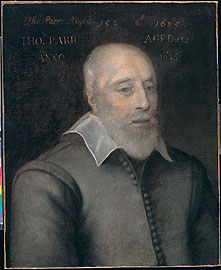
Parr Portrait (2)


Oil on canvas. 65 x 53 cm.
This painting appears to have an authentic likeness and seems fleetingly sketched while Parr was alive. The painting also has a convincing contemporary inscription. Parr had long been blind. The eyes in this portrait are correspondingly hollow but they are open and it does appear that this painting was executed ad vivum, in other words, when Parr was alive.

Inscribed twice recto in a seventeenth-century writing:
Tho Parr. Aiged. 152.A.[o] 1635.
and in a later writing, probably eighteenth-century:
THO.S PARR AGED 152 / ANNO 1635.

Old Parr Iconofraphy

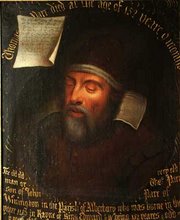
There is a very large and dubious iconography for ‘Old Parr’ including portraits by Van Dyck and Rubens, the latter apparently from memory (engraved for the European Magazine by John Condé in 1793).Many portraits are known but these invariably appear to be painted posthumously.

Wednesday, September 27, 2006

Parrs death and otopsy

After his death, King Charles ordered an autopsy and it showed the cause of death was brought on by unaccustomed luxuries and indulgences. The slightest cause of death could not be discovered, and the general impression was that he died from being over-fed and too-well treated in London.
In the post mortem carried out by the eminent physician Dr William Harvey examined his body and at the necropsy the old mans internal organs were found in a most perfect condition,
-the colon resembled that of a child's.
-his cartilages were not even ossified, as is the case generally with the very aged.
The autopsy on Parr was widely interpreted as verifying his extreme age.

Wrote Harvey:
The genital organs were in good condition, the penis was neither retracted nor thin, nor was the scrotum, as is usual in old persons, distended by any watery hernia, while the testicles were large and sound -- so good in fact as not to give the lie to the story commonly told of him that, after reaching his hundredth year, he was actually convicted of fornication and punished. Moreover, his wife, a widow, whom he had married in his hundred and twentieth year, in reply to questions, could not deny that he had had intercourse with her exactly as other husbands do, and had kept up the practice to within twelve years of his death. [...]
The cause of death seemed fairly referrible to a sudden change in the non-naturals, the chief mischief being connected with the change of air, which through the whole course of life had been inhaled of perfect purity – light, cool, and mobile, whereby the praecordia and lungs were more freely ventilated and cooled; but in this great advantage, in this grand cherisher of life this city is especially destitute; a city whose grand characteristic is an immense concourse of men and animals, and where ditches abound, and filth and offal lie scattered about, to say nothing of the smoke engendered by the general use of sulphureous coal as fuel, whereby the air is at all times rendered heavy, but much more so in the autumn than at any other season. Such an atmosphere could not have been found otherwise than insalubrious to one coming from the open, sunny, and healthy region of Salop; it must have been especially so to one already aged and infirm.
Of course, it is rather unlikely that he was actually born in 1483. Harvey himself was in no condition to know his proper age, and nothing he said gave any indication of any memories from the 15th century, rather unusual as those would likely be his most vivid memories. While Parr was undeniably old, the scenario sometimes posited is a confusion (deliberate or no) of this Parr's birth record with that of his grandfather.
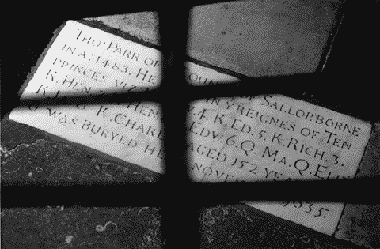
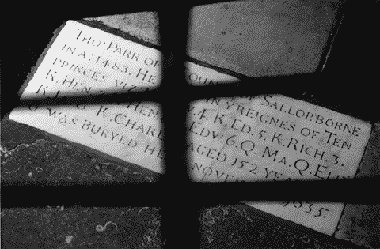
The Gravestone at Westminster Abbey


The inscription on his gravestone reads:
THO: PARR OF YE COUNTY OF SALLOP. BORNE
IN AD: 1483. HE LIVED IN YE REIGNES OF TEN
PRINCES VIZ: K.ED.4. K.ED.5.K.RICH.3.
K. HEN. 7 .K.HEN. 8.K.EDW. 6.Q.MA.Q.ELIZ
K.JA. & K. CHARLES. AGED 152 YEARES.
7 WAS BURYED HERE NOVEMB. 15. 1635.

The Brand for Quacks

Perhaps one of the most ingenious devices in the art of quackery is that by which a well-known medicine, bearing Parr's name, is vaunted to the public as the mysterious preparation by which he was enabled to attain the extraordinary age of a hundred and fifty-two.
The portrait which is frequently attached to the puffing placard advertising these drugs, is derived from a likeness of Old. Parr, drawn by the celebrated painter Rubens.

Taylors poetic report 2

Good wholesome labour was his exercise,
Down with the lamb, and with the lark would rise:
In mire and toiling sweat he spent the day,
And to his team he whistled time away:
The cock his night-clock, and till day was done,
His watch and chief sun-dial was the sun.

He was of old Pythagoras' opinion,
That green cheese was most wholesome with an onion;
Coarse meslin bread, and for his daily swig,
Milk, butter-milk, and water, whey and whig:
Sometimes metheglin, and by fortune happy,
He sometimes sipped a cup of ale most nappy,
Cycler or perry, when he did repair
T' Whitson ale, wake, wedding, or a fair;
Or when in Christmas-time he was a guest
At his good landlord's house amongst the rest:
Else he had little leisure-time to waste,
Or at the ale-house huff-cap ale to taste;
His physic was good butter, which the soil
Of Salop yields, more sweet than candy oil;
And garlick he esteemed above the rate
Of Venice treacle, or best mithridate.
He entertained no gout, no ache he felt,
The air was good and temperate where he dwelt;
While mavisses and sweet-tongued nightingales
Did chant him roundelays and madrigals.
Thus living within bounds of nature's laws,
Of his long-lasting life may be some cause.

Buried in Westminster Abbey


The King ordered his burial in the Abbey and his grave has been pointed out to visitors ever since. Parr is celebrated by a monument reared to his memory in Westminster Abbey.
He was buried in the south transept of Westminster Abbey
He was buried in Westminster Abbey by order of King Charles I. The inscription on his small white marble gravestone in the centre of the South Transept reads:
‘Old Parr’ as he was known was buried at Westminster Abbey by order of the King. He was buried in the south transept of Westminster Abbey where the inscription over his grave reads: